
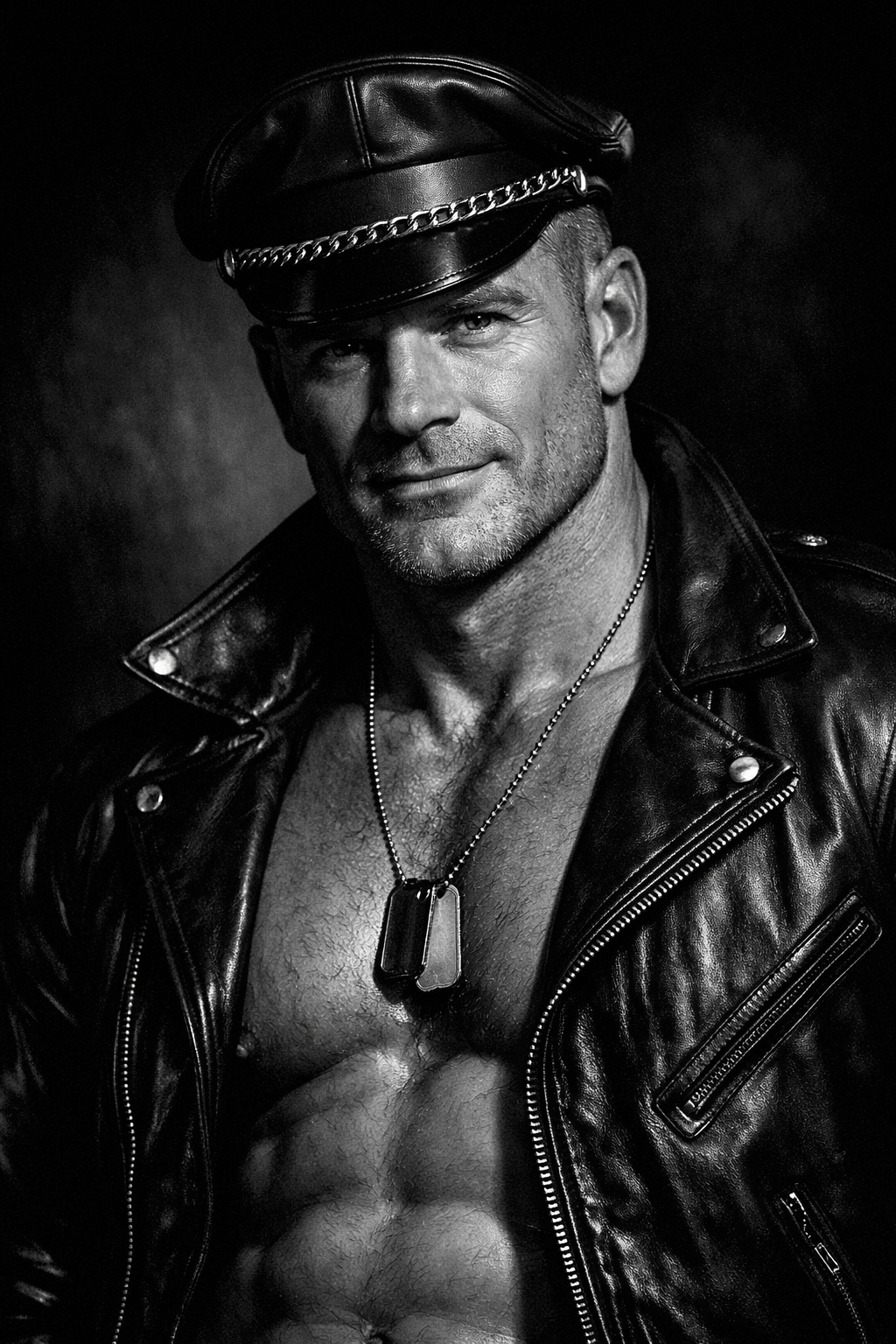
Most people encounter Leather through surface impressions—leather jackets, boots, harnesses, a room charged with quiet intensity, a title sash worn under bright lights. Some recognize it as kink and assume it begins and ends with sex acts. Others dismiss it as style, a look that can be tried on briefly and abandoned without consequence. Both interpretations stop at the surface, and both fail to explain why Leather endures.
Leather is a culture—a lived system of community, structure, identity, ethics, relationship practice, and public belonging built around consensual power exchange. It is recognizable not only by its symbols but by the repeatable ways people relate to one another: through mentorship, chosen family, service, accountability, and a shared language of roles and conduct that survives beyond any single bar, event, or relationship. It sits at the intersection of kink and sexuality, but also care and community continuity.
The material culture matters—jackets and vests are not just clothing but biographies, bearing patches earned, pins collected, and memorials carried. These objects become visible records of where someone has served and who they have stood with.
What distinguishes Leather from casual kink or recreational BDSM is not intensity but infrastructure built through shared history. Leather provides something broader kink culture often doesn’t: a complete ethical framework for holding power safely over time, embedded in community institutions that teach, witness, and hold people accountable. It’s the difference between “I do kink” and “I am accountable to people who will still know my name five years from now.”
That accountability changes behavior. It rewards competence, care, and discretion. It responds to recklessness and predation, even when legal systems won’t.
At its core, Leather is this: disciplined power made livable through protocol, passed down through lineage, and held accountable by community. It is authority that doesn’t turn off when sex ends. It is submission that extends beyond bedroom into how someone moves through the world. It is power structured by ethics that matter more than desire, and discipline that outlasts intensity.
Leather is what happens when the urge to dominate or submit meets responsibility—when pleasure is made safe through structure, and power becomes something you’re trusted with rather than something you simply take.
Why Leather Had to Be This Way
Leather did not emerge from freedom or abundance. It was forged by necessity, built by men who had no choice but to be disciplined because anything less could destroy not just individuals but entire networks of community and safety.
In mid-twentieth century America, Leather emerged at the collision point between gay men living under constant danger and men attracted to men who were drawn to dominance, submission, and sadomasochism. Homosexuality was criminalized across the country. Federal agencies tracked known homosexuals. Police raided bars regularly and published arrestees’ names in newspapers, ensuring that exposure meant loss of employment, family relationships, and social standing. Blackmail was routine. Institutionalization was common. Violence was expected.
Even within queer communities, men drawn to BDSM were often further marginalized, viewed as dangerous, perverse, or politically inconvenient. The closet was not metaphor—it was a survival strategy, and stepping outside it carried catastrophic risk. These overlapping pressures made separation impossible and community inevitable: men who were already outcast had no choice but to build something private, disciplined, and self-protective together.
In this environment, gay men needed ways to find one another, organize safely, and build identities that countered the dominant narrative that they were either tragic, sick, or fundamentally unserious. They needed systems that could function without legal protection, spaces where desire could be expressed without apology, and codes of conduct that kept people safer when mainstream institutions would not.
Motorcycle clubs provided one of the first viable organizational models, but they were not the only structures to emerge. As men attracted to men who practiced BDSM found themselves increasingly marginalized—even within queer spaces—purpose-built BDSM clubs and societies began to form. These were not social clubs in the casual sense; they were tightly controlled, invitation-based environments designed for discretion, vetting, and shared risk.
Groups like the Satyrs Motorcycle Club (Los Angeles, 1954) and Oedipus Motorcycle Club (1958) demonstrated how hierarchy, membership rules, and shared identity could protect participants. BDSM-focused clubs adapted those lessons, creating private spaces where dominance, submission, sadomasochism, and fetish could be explored under strict internal rules. Entry was monitored, behavior was regulated, and reputation mattered.
These early BDSM clubs functioned as laboratories for Leather ethics—testing consent practices, enforcing protocol, and establishing the expectation that participation required accountability. They were not merely places to play; they were structures that allowed men to explore forbidden desire while minimizing the risk of exposure, exploitation, or chaos. In this way, BDSM clubs became as foundational to Leather culture as motorcycle clubs: parallel infrastructures that converged out of necessity, each reinforcing the need for discipline, hierarchy, and collective responsibility.
Masculinity itself was not only protective—it was erotic. Men dressing in gear was hot. Boots, leather jackets, uniforms, denim, sweat, weight, body hair, posture: these things carried charge long before anyone theorized them. The look worked because it was real—masculine men desiring masculine men, unapologetically sexual, physical, and present. Leather style didn’t emerge despite desire; it emerged because desire needed a visible language. What began as camouflage quickly became magnetism.
The gear made bodies readable to one another. It signaled availability, appetite, and shared taste. This is where Leather becomes unmistakably sexual: hot men creating iconic looks that eroticized power, labor, dominance, and control. Artists like Tom of Finland didn’t invent this—they reflected it back to the community, turning lived desire into imagery that affirmed what many men already felt but rarely saw acknowledged: that masculinity itself could be the object of lust, and that sex between men could be aggressive, disciplined, and beautiful.
But sex alone was not enough to hold what they were building. Desire brought men together; structure kept them from tearing one another apart.
Survival required internal governance because external systems offered no protection. In a world without legal recourse, loyalty had to replace law, reputation had to replace contracts, and protocol had to replace formal regulation. Coded systems—the hanky code being the most well-known—emerged not as playful flirtation but as efficient sexual shorthand, a way for men to signal roles, interests, and boundaries quickly in environments where explicit conversation about sex could invite violence or arrest. These systems allowed desire to move fast while keeping risk contained, ensuring that erotic charge did not outpace judgment.
This is where Leather’s foundational truth crystallized: the more extreme the behavior, the more rigorous the ethics must be. A single careless person could expose an entire network. One act of betrayal could lead to raids, arrests, violence, destruction of livelihoods. One moment of poor judgment could cost not just individuals but entire communities. Leather culture understood instinctively what mainstream society often refuses to accept—that when stakes are absolute, ethics cannot be optional.
So they built internal law. Consent was codified early. Discretion became absolute. Reputation mattered intensely because reputation was the only currency that worked when legal contracts couldn’t protect you. Loyalty was enforced not through courts but through social consequence—ostracism, banning from spaces, stripping of titles and recognition. These weren’t arbitrary punishments. They were survival mechanisms protecting the culture from those who would cause harm without accountability or betray trust without consequence.
By the 1970s, communities were formalizing education and mutual support. The Eulenspiegel Society, founded in New York in 1971, focused on adult consensual sexual liberation and instruction. On the West Coast, the Society of Janus, established in San Francisco in 1974, positioned itself around education and support for kink and power exchange, emphasizing consent and non-exploitation as core commitments. By the early 1980s, Gay Male S/M Activists had explicitly centered “safe, sane, and consensual” as the baseline ethical framework—not perfect language, but a public claim that consensual kink could be distinguished from abuse, and that the community itself would define and enforce those boundaries.
Leather also began institutionalizing celebration and visibility through events that functioned as both gathering points and community infrastructure. International Mr. Leather began in 1979, growing from Chicago bar contest culture, and evolved into a major annual convening that created networks, supported organizations, and established a common calendar—key ingredients of any durable culture. These weren’t merely pageants; they were transmission mechanisms where standards were demonstrated, lineage was preserved, protocol was taught, and accountability became visible.
Then came AIDS.
The crisis shaped everything about modern queer community formation, including Leather. AIDS wasn’t only a tragedy of death—it was catastrophic loss of knowledge, relationships, archives, and continuity. When mainstream institutions, families, and society refused to recognize what queer lives meant, entire networks of memory were at risk of erasure.
This is the context in which the Leather Archives & Museum was founded in Chicago in 1991 by Chuck Renslow and Tony DeBlase, with an explicit mission to preserve and make accessible leather, kink, and fetish history through research, preservation, and education. Its origin story emphasizes the AIDS-era urgency: artifacts, stories, and records were being discarded or suppressed, and if the community didn’t preserve its own history, no one else would do it correctly—or at all.
This compressed history answers why Leather is structured the way it is. It wasn’t accident or excess. It was adaptation—to stigma, to policing, to the fragility of queer life, and to the need for spaces where desire could be expressed with both freedom and discipline. The protocols, hierarchies, and accountability mechanisms weren’t invented to make power exchange complicated. They emerged because extreme desire in dangerous conditions requires extreme discipline.
How Leather Works
Leather functions through three interlocking systems that transform individual desire into collective safety: protocol, roles, and community accountability.
Protocol is often misunderstood as theater or nostalgia for military formality. In reality, protocol is behavioral law—the encoding of ethics into repeatable action so expectations are clear before desire escalates. In early Leather spaces, protocol answered critical questions without lengthy conversation: Who holds authority here? Who is responsible if something goes wrong? How is consent given and how is it withdrawn? How are boundaries maintained when direct negotiation isn’t always possible?
These weren’t abstract concerns. When bars could be raided and private spaces compromised, protocol provided instant clarity. Kneeling before speaking wasn’t erotic decoration—it was acknowledgment of power structure. Waiting for permission to approach wasn’t psychological delay—it was consent architecture, ensuring touch happened only when truly wanted. Eye contact rules, forms of address, physical positioning—these created predictable interaction pathways that reduced the risk of miscommunication when miscommunication could be catastrophic.
Protocol also functioned as ethical training. Leather never assumed that desire automatically qualified someone to dominate or submit. Protocol taught how to approach authority without entitlement, how to receive service without exploitation, how to correct without cruelty, how to discipline without losing emotional control, how to care for those you command. A Dominant who couldn’t follow protocol wasn’t considered strong—he was considered dangerous, untrustworthy with the vulnerability others might offer.
Protocol created what communities needed most: a way to make power legible and safer. It’s how a culture teaches people to distinguish scene behavior from everyday conduct, how to host responsibly, how to decline cleanly, how to negotiate clearly, and how to prevent charisma from becoming coercion. Protocol is the container that keeps sadism from becoming cruelty, authority from becoming tyranny, submission from becoming self-erasure, and desire from becoming recklessness.
As Leather culture matured, generic categories like top and bottom evolved into specific relational structures, each representing different philosophies of power and care. These roles became more than bedroom preferences—they became relational identities recognized and enforced by community.
Sir and boy dynamics center on formation through discipline. The Sir’s authority is instructional, shaping behavior, bearing, protocol, and self-mastery not to erase identity but to refine it—to make someone sharper, more capable, more fully themselves. This structure draws from military and fraternal mentorship traditions. The core ethic is clear: I am responsible for what you become. The Sir is judged not by how much control he asserts but by the quality of the person he develops. If a boy fails, the Sir has failed in his duty to train properly.
Daddy and boy dynamics center on protection and emotional stability. This role emerged in response to the reality that many queer men had been severed from biological family, denied stable attachments, exiled from the safety family structures typically provide. Daddy authority isn’t about testing limits—it’s about creating reliable security. Discipline exists, but its purpose is grounding rather than growth through challenge. The core ethic: you are safe because I remain present, and I will not abandon you. The Daddy is judged by the stability and security he provides, by his ability to be constant when everything else may be uncertain.
Master and slave dynamics represent the most formalized expression of Leather power. This isn’t situational dominance that turns on and off—it’s long-term stewardship, often extending into daily life. Ownership in this context isn’t claimed lightly. It’s negotiated carefully, witnessed by community, and bound by absolute accountability. The Master doesn’t seize a slave’s will; he accepts responsibility for carrying it, for making decisions on behalf of someone who has chosen to surrender that burden within negotiated bounds. The core ethic: your surrender is entrusted to me, and I will honor it with my life. The Master is judged by the well-being and fulfillment of the person whose will he holds.
In every case, the principle remains constant: the greater the power, the greater the obligation. These aren’t bedroom labels adopted for erotic flavor. They’re offices of responsibility, carrying expectations about conduct in both private and public Leather spaces. When someone claims Sir, Daddy, or Master without accepting the responsibility those titles carry, they’re not practicing Leather—they’re wearing someone else’s uniform without earning it.
The third pillar is community accountability. Leather culture survives because it’s self-regulating. When external legal systems wouldn’t protect queer men—when going to police was often more dangerous than staying silent—Leather communities built internal governance. Reputation traveled through networks. Information about those who violated trust or caused harm spread through word of mouth. Consequences were social rather than legal: banning from spaces, ostracism, stripping of titles, exile from community.
This enforcement wasn’t arbitrary or vindictive. It protected the culture from those who would treat power as consumption rather than stewardship, who would harm without accountability, who would betray trust without consequence.
Gatherings like International Mr. Leather and Folsom Street Fair weren’t just celebrations—they were transmission mechanisms where standards were demonstrated, lineage was preserved, protocol was taught, and accountability was made visible. Title systems created visible role models and incentive structures for service: someone steps into public scrutiny, agrees to represent something beyond themselves, and commits to travel, education, fundraising, and bridge-building.
Mentorship is the heartbeat of transmission. Many Leather communities explicitly emphasize person-to-person teaching—”each one teach one”—which assumes the culture is worth passing on and that responsibility for doing so is distributed rather than centralized. For newcomers, mentorship is often the difference between entering safely and entering as prey. Leather is full of intense desires and unequal power dynamics; those aren’t flaws but features. But they require guardrails. Mentorship provides those guardrails without demanding every lesson be learned through injury.
Service roles matter as much as authority roles. Bootblacking is one of the clearest examples—both practical and symbolic. The care of boots is the care of a uniform, and the uniform is the care of the culture’s visible language. That’s why competitions and honors formed around it. Even if someone never gets their boots shined, the existence of a respected service role communicates something essential: you don’t merely consume Leather; you contribute to it.
Institutions make the culture legible and durable. Shops can be more than retailers—they become community anchors. Mr. S Leather, founded in San Francisco’s South of Market neighborhood in 1979, functioned not just as a store but as a gathering point and community center over decades. Archives preserve what would otherwise be lost. The Leather Archives & Museum exists because community leaders understood that if they didn’t keep their own history, nobody else would—and much would simply disappear, discarded by families who didn’t understand its value or deliberately suppressed by those who found it shameful.
This is also where inclusion work becomes structural rather than rhetorical. Leather culture includes many genders and orientations, and it has specific lineages—particularly gay male lineages—that deserve to be named without apology. But inclusion means more than “everyone is welcome.” It means who is safe, who is centered, who is heard, and who has access to leadership. Organizations like ONYX exist precisely because mainstream Leather spaces didn’t always serve gay and bisexual men of color adequately. ONYX’s mission is explicit: to educate and empower gay, bisexual, and queer men of color who explore the Leather lifestyle, and to be a leading resource focused on that empowerment. That’s not peripheral to Leather—it’s Leather doing what it claims, building durable community by correcting exclusion through institution-building.
Why Leather Still Matters Now
The conditions that created Leather have changed dramatically. Homosexuality is legal across much of the United States and many other countries. Kink has mainstream visibility. Bars aren’t raided. The threat of arrest for consensual adult behavior has largely disappeared in many places. Apps and online communities make it easier than ever to find partners and learn techniques.
So why does Leather still matter? Why maintain these demanding standards when the original necessity has passed?
Because what Leather offers has nothing to do with whether it’s legally necessary. Leather provides something that casual kink culture, modern BDSM communities, and recreational power exchange typically don’t: a complete ethical framework for holding extreme power safely over time, embedded in public institutions that can teach, witness, and hold people accountable.
The world has changed, but human psychology hasn’t. Power still corrupts when left unstructured. Desire still escalates beyond sound judgment. Submission still carries risk of losing yourself. Sadism still borders cruelty. The temptation to take more than was offered, to push harder than is safe, to prioritize your own gratification over someone else’s well-being—these don’t disappear because the law has changed or apps exist.
Modern kink culture often treats consent as sufficient—as though initial agreement makes everything that follows acceptable. But consent can be manipulated. It can be given by someone who doesn’t fully understand what they’re agreeing to. It can be present at the start of an encounter and absent by the end. Consent doesn’t prevent harm; it only establishes that harm was initially agreed to. That’s necessary but not sufficient.
Leather demands more. It demands integrity throughout the entire arc of power exchange, not just at negotiation. Consent is necessary, but so is continuing care after consent is given. Negotiation is necessary, but so is conduct that matches what was promised. Desire is acknowledged, but so is the discipline to restrain desire when continuing would cause harm. Authority is recognized, but so is accountability when that authority is misused. Leather says: we agreed to this, and I remain responsible for you throughout and after, regardless of what you technically consented to.
That ethic is as necessary now as sixty years ago, because power doesn’t become safe simply because it’s legal. It becomes safe when it’s structured, witnessed, and held accountable by something larger than individual desire.
Leather also offers what the contemporary world increasingly lacks: lineage and continuity. In a culture obsessed with individual reinvention and the rejection of tradition, Leather says something radically different: you are not the first person to hold this kind of power. Others came before you. They made mistakes. They learned hard lessons. They developed methods that work, protocols that protect, ethics that prevent common failures. You inherit those methods, and you’re accountable to them.
That continuity has practical value. It means you’re not alone, reinventing power exchange from scratch with only your desires and limited experience to guide you. You’re part of a culture with deep memory, tested approaches, elders who can teach, and peers who can witness and correct. You have access to accumulated wisdom about navigating hard situations—what to do when consent changes mid-scene, how to provide care after intense experiences, how to handle emotional aftermath when something goes wrong, how to repair trust after you’ve broken it.
Leather treats power as cultural responsibility, not individual preference. It’s something passed down, something you’re trained into, something you answer for. In a world where kink has become commodified and aestheticized, where “Dominant” and “submissive” are often treated as personality types rather than roles requiring specific skills and ethics, Leather remains uncompromising. It doesn’t soften standards to be more inclusive. It doesn’t lower expectations to attract more people. It doesn’t prioritize making everyone comfortable over maintaining integrity.
This matters because mainstreaming tends to extract aesthetics while abandoning ethics. When Leather becomes content, pressure to perform can outpace readiness to consent or lead. When social media turns identity into branding, people chase status faster than they build character. That’s precisely where older Leather ethics become essential: slow down, be mentored, learn negotiation, earn trust, treat community spaces as shared resources—not personal stages.
Leather also matters because cultural memory is fragile. When queer people die and their lives are misunderstood, their history can be discarded quickly—objects, photos, letters, patches, magazines, club records, all of it. Leather’s insistence on preserving artifacts and stories isn’t nostalgia; it’s survival. When a culture is continually misrepresented, documentation becomes armor. The explicit preservation mission of the Leather Archives & Museum exists because leaders understood that without active stewardship, their history would be erased or fundamentally distorted.
And Leather matters because it can hold paradox without collapsing. It can be sexual without being shallow, hierarchical without being abusive, private in practice while maintaining public community standards. It can honor tradition without pretending the past was perfect. It can maintain role clarity while adapting language to be more inclusive and less harmful. The culture’s strongest leaders tend to do two things simultaneously: preserve what protects people—consent, ethics, accountability, mentoring—while retiring what excludes people unjustly.
None of this means Leather is for everyone, and it shouldn’t try to be. Some people are drawn to power exchange as occasional recreation—intense experience sought when the mood strikes, then set aside when ordinary life resumes. That’s legitimate. Some people want kink without community, without elders, without the weight of tradition or the obligation to carry something forward. That’s also legitimate. Leather doesn’t condemn those choices; it simply isn’t built for them.
Leather is built for people who recognize that their relationship to power isn’t recreational—that dominance or submission or service isn’t something they do but something they are, and that being it well requires more than desire. It’s for people who want their intensity witnessed and tested, who understand that accountability isn’t restriction but protection, who find meaning in the idea that others came before them and others will come after, and that they’re responsible to both.
The culture asks a question before it offers belonging: Can you hold what this requires? Not perfectly—no one holds it perfectly—but sincerely, with willingness to be corrected, to learn slowly, to submit your conduct to standards older than your preferences. If the answer is yes, there’s a path. If the answer is no, or not yet, that’s information worth having.
For newcomers entering now, Leather offers deliberate intimacy in a world that often degrades it. Protocol and negotiation slow people down. Service teaches attentiveness. Mentorship teaches patience. Reputation teaches long-term thinking. None of that is guaranteed in a swipe-based world, and none of it’s automatic even inside Leather. But Leather is one of the few erotic cultures that built those mechanisms into its identity from the beginning—not as afterthought, but as prerequisite for doing what it does.
Leather is not preserved because the past was better. It’s preserved because the past was dangerous, and people built systems that made danger navigable—ethically, socially, and erotically. Those systems still have value even when external threats look different. Today’s threats are often softer but no less real: isolation, predation hidden behind charisma, misinformation disguised as confidence, and the loss of community standards in purely private kink.
A newcomer who wants to enter respectfully can start with three commitments. First, treat Leather as a culture you’re visiting, not a costume you’re borrowing. Second, value competence over performance: seek teachers, ask questions, learn safety, and take time. Third, understand that belonging is built through contribution—showing up consistently, respecting boundaries, helping with the work, and carrying the ethic forward when it would be easier not to.
Leather is what happens when people who hold intense power over one another decide that the weight of that power matters more than the pleasure it provides. It is the practice of chosen, consensual power—and the public responsibility that comes with it. That responsibility shows up in how you host, how you negotiate, how you refuse, how you repair, how you mentor, how you honor consent, and how you treat the community’s history as something you steward rather than consume.
Leather says clearly: this is what it is, this is what it costs, this is what it demands. If you can carry it, if you recognize yourself in these standards and are willing to submit to them, there is a path. If you cannot or will not, that’s perfectly fine—there are many other ways to explore power and desire. But do not dilute what you are not willing to sustain.